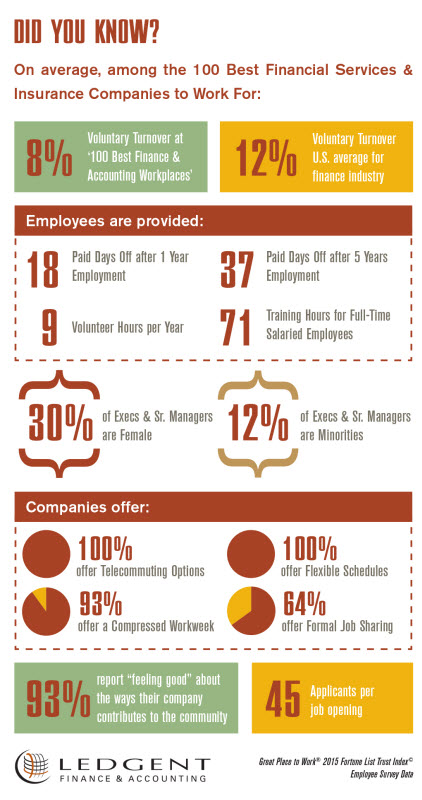
Every Finance & Accounting department and firm has its own unique personality and characteristics, but creating a great workplace within the Finance industry has universal factors like flexibility, training, and community involvement.
While these may be aspects that you may not have control over, bosses and managers are major catalysts for change … any position of influence requires a delicate balance.
Ask yourself, do your daily actions in the workplace make life better for your employees, or just you?
As the manager, know that you build and maintain your own MICRO-culture. Your team will stay devoted to you if you are committed to creating a space of appreciation, recognition, and empowerment.
Here are 5 simple ways to build a great Micro-culture that will not only create a great place to work, but loyalty as well:
Keep your promises.
Psychological Contracts are the mutual expectations employees and managers have for one another, many go unsaid and most go beyond the paycheck. These psychological contracts have a major effect on employee perceptions of fairness. Discuss with your employees their expectations and have defined (even documented) expectations for one another. This will increase accountability for both sides and serve as a reference point if anything goes awry.
Give credit, and give it generously.
Inc., Forbes, and Quandora all report similar versions of what employees desire from their employers; but “feeling important/ valued” always comes out on top. Recognition and gratitude are simple ways to communicate value to your employees. Before you set a reminder on your calendar to thank your employees every Tuesday, remember that gratitude must be sincere, not a robotic gesture or an obligation.
Easy on the micromanaging.
Just like you know how to do your job, your employees (hopefully) know how to do theirs. Try your best not to knit pick or micromanage, while still giving guidance. If you’re worried about whether an employee will deliver, try saying something along the lines of: “Debbie, I am trusting you to complete this on time, because I know you are so punctual.” Debbie will accept the responsibility and feel empowered simultaneously. If your employees are unprepared for a project, it is your responsibility to get them the tools or training they need.
Share knowledge, share power.
If you won the lottery tomorrow, who would take over your position? An external hire takes time and money, and promoting the wrong person takes its toll on any business. Prepare your team to move forward with their careers, managerial or otherwise.
Know when to look in the mirror, and when to look through the window.
Leadership comes with plenty of responsibility, and self-awareness is key. When something goes well, “look through the window” at your team and give them the credit they deserve. When things go wrong, “look in the mirror” at yourself to understand your role. Evaluate your leadership style and how you can improve as a leader (review instructions, communication style, follow up processes, etc.), but no self-deprecation. Encourage your employees to do the same, create a culture of accountability.
Being the boss is hard work, and your organization may or may not have the best programs in place to create an engaging workspace. But these are small, cost-free actions that you can implement on a daily basis that will communicate value to your employees. Create a legacy for helping others, developing talent, and ultimately accomplishing impressive business results, your team and your organization will be better for it.
For more information about how Ledgent can help you with your hiring, visit www.ledgent.com.