We’ve had a very tumultuous year, which tossed the political world and feelings of voters upside-down in 2020. On November 11, nationally recognized political analyst Dr. Susan MacManus provided her post-election insights and opinions on voting and turnout patterns and key events that influenced the outcome to the Tampa Bay chapter.
From the beginning to the end, Florida was considered a toss-up state, and one of the biggest at that since the last five prior elections had seen a 1% major of victory. It’s important to examine what makes Florida the nation’s most unique and diverse swing state:
Party registration and competitiveness - A big story surrounded the Florida party registration trend, the enthusiasm gap and the growing number of people registered independent. By the end of the registration period, Democrats only outnumbered Republicans by 134,000 out of 14.4 million registrants in Florida.
Race/ethnic diversity - Our racial and ethnic diversity is unparalleled in any state. 1/3 of registered voters are non-white.
Age diversity - Even though outside analysts may sometimes perceive it as an ‘old folks state,’ Millennials (ages 24-39) and Generation Z (ages 18-23) make up more than 30% of registered voters.
Geographical location differences - There is an increasing divide between the rural and urban areas in how they’ve voted in the past.
However, in the end, Florida was different than the country. The polls were wrong, and badly at that. The day before the election, the Real Clear Politics projected Biden would win by 1%, when in reality Trump won by 3.4%. Research has shown that if a candidate is far ahead in the polls, come election day, that some of a candidate’s supporters may be less likely to vote, becoming complacent. Bad polling hurts both voters and the candidates.
Dr. MacManus cited several reasons why the polls were wrong, but her most important message when she discusses media and polling is
you cannot predict turnout.
So why did Republicans win Florida? They had a better ground game, knocking on 3 million doors in the state. The Florida GOP was more effective in registering and asking about the issues, utilizing phone banks and peer-to-peer texting. Florida Democrats and the Biden campaign didn’t fund canvassing and the get-out-the-vote efforts early enough, especially in Hispanic neighborhoods.
Some interesting facts about Florida’s results:
- Florida had the highest voter turnout since 1992
- Hillsborough County was in the top 5 of Florida counties with a turnout increase, up 5.2%. Florida statewide had an increase of 2.7%
- Three counties flipped from Trump in 2016 to Biden in 2020 – Duval, Pinellas and Seminole
- Florida and Pennsylvania were the recipients of the most presidential candidate visits
- Trump’s vote share increased in in all five counties with the highest share of Hispanic voters
- Only 17% of voters cast their vote on election day in the state. 44% were vote-by-mail and 39% were early vote.
- More money on TV ads was spent in Florida than any other swing state. Biden outspent Trump 3 to1, where Biden and allies spent $154.1 million ($82.3 million from the campaign), which Trump and allies spent $103.4 million ($67.7 million from campaign). A total $257.5 million was spent across both campaigns in our state. A chart of the media markets is shown below.
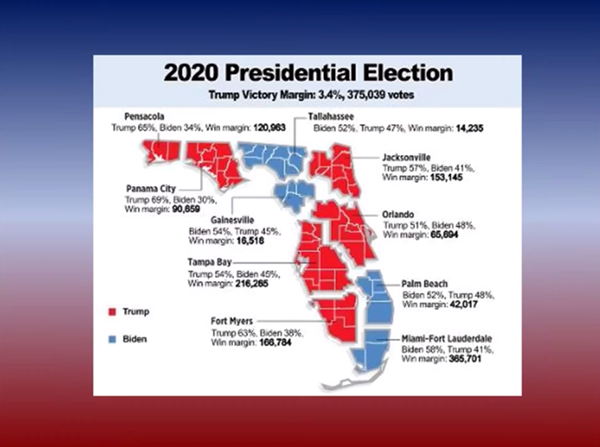
The bottom line is you really have to study our demographics in the state to get a feel for things. And this election leaves the question, is Florida still considered a swing state? That is in the eyes of the beholder. Republicans would say yes since the margin of victory was 3%, while Democrats would say no, citing a bad campaign.
Dr. MacManus left chapter members with two certainties:
- Florida has shed its “Flori-duh!” title when it comes to running an election
- The 2020 Election may have something to please everyone, with Republican wins at congressional and legislative levels, while Democrats have a Biden presidency
To watch the full webinar, visit our
YouTube page.
About our speaker:
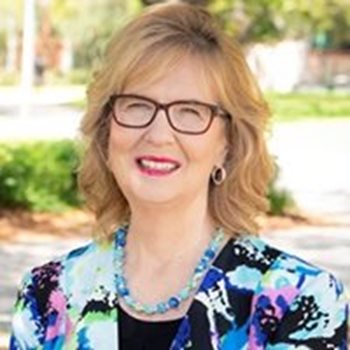
Dr. Susan MacManus is a recently retired USF professor and the most widely and highly respected observer of Florida politics. Read more about this
speaker.